The Product Was Ready. The World Wasn't Watching.
Every solo founder knows distribution matters. Most still launch to silence. The gap isn't strategy — it's the bandwidth to keep marketing moving while also building the product.
I've read some version of this story at least twenty times in the last year.
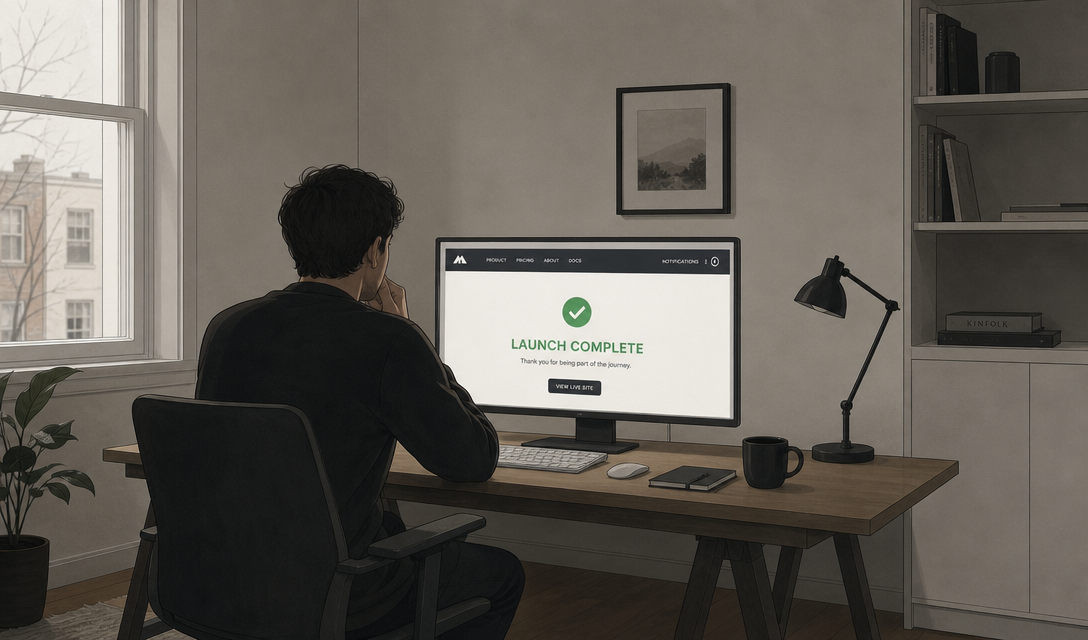
A founder — usually technical, usually working alone — spends months building something real. They push to launch. Maybe they post on Product Hunt, write an announcement tweet, drop a message in a few Slack communities. Then they wait.
Seven days later: four signups. Two of them are friends.
An indie hacker named Richardodds described it plainly in a post on Indie Hackers in June 2026: "The most common and most expensive mistake in indie hacking." He noted that the typical indie hacker has about 432 Twitter followers at launch — not a lot of surface area for a product announcement to land.
I don't think the problem is the product. I've seen genuinely good products go quiet at launch. The problem is distribution — the slow, uncomfortable, unglamorous work of making sure the right people know something exists.
And here's what makes this hard to solve: you already know this. I knew this. Every founder who's read Paul Graham or lurked on Hacker News knows that distribution matters. The advice isn't hard to find. The execution is.
Why Knowing Doesn't Help
I started building VibeCom because I was experiencing the problem myself.
I shipped features. I had a product. I'd built a SaaS to $1M ARR before, so I wasn't naive about what distribution required. And I still couldn't keep marketing moving consistently while also building the product.
The issue wasn't knowledge. It was bandwidth.
When you're building alone, your cognitive resources are almost entirely consumed by the product. What to build next. What's breaking. What users are confused by. The edge cases. The infrastructure. By the time you've handled all of that, "post on LinkedIn today" has slid off the list again. Not because it didn't matter. Because you ran out of day.
This is different from not knowing what to do. It's closer to what happens when you know exactly what to do and still can't do it consistently, because every hour you spend on distribution is an hour not spent on the product, and the product is the thing that feels most urgent.
The Problem Isn't Strategy, It's Execution
Lilach Bullock, who's built three businesses, describes it as a capacity problem, not a strategy problem. Most marketing advice assumes 20+ hours a week of dedicated marketing time. Solo founders don't have that. Even the lightest single-channel strategy — email, one LinkedIn post a week, nothing else — realistically requires 2-5 hours every week, indefinitely.
That number sounds small until you're doing it while also being the product manager, the developer, the support team, and the one who handles the billing system when something breaks at 11pm.
The conventional answer is "hire a marketer." That's fine advice for a company with revenue to support it. For most solo founders in the early stages, it's not where you are.
What I'm Building Toward
VibeCom exists because I couldn't find a tool that handled the execution problem, not the strategy problem.
I didn't need another AI writing assistant that produces generic content I have to rewrite. I needed something that understood what VibeCom actually does, knew what I'd already posted, could track what was happening in my competitive space, and would create real usable content from that context — so that my job became a 5-minute review instead of a 3-hour content sprint.
That's a different problem than what most tools solve. Most tools make it easier to write. This problem is about making it possible to show up consistently without writing being the bottleneck.
I'm still building toward that vision. The product isn't done. But the hypothesis feels right: technical founders don't have a strategy problem. They have a time problem. And the only way to solve a time problem at scale is to automate the parts that don't require the founder's specific judgment.
The Gap Between Knowing and Doing
The story Richardodds told — launch to silence, then slowly rebuilding through direct outreach and genuine community presence — has a good ending. He built an audience, got signal, moved the product forward.
But the gap he described — between knowing that distribution matters and actually keeping it moving while building — is still the default experience for most solo founders. Including me.
I'm not writing this to pitch VibeCom. I'm writing it because thinking through the problem out loud is part of how I figure out whether I'm solving the right thing.
So far, I think I am.
Condividi questo
Scritto da Feng Liu
shenjian8628@gmail.com