AI Agent Observability Is the Blind Spot Killing Your Production Agent
90% of founders only learn their AI agents failed when a customer complains. Here's the AI agent architecture tutorial on observability nobody's writing.
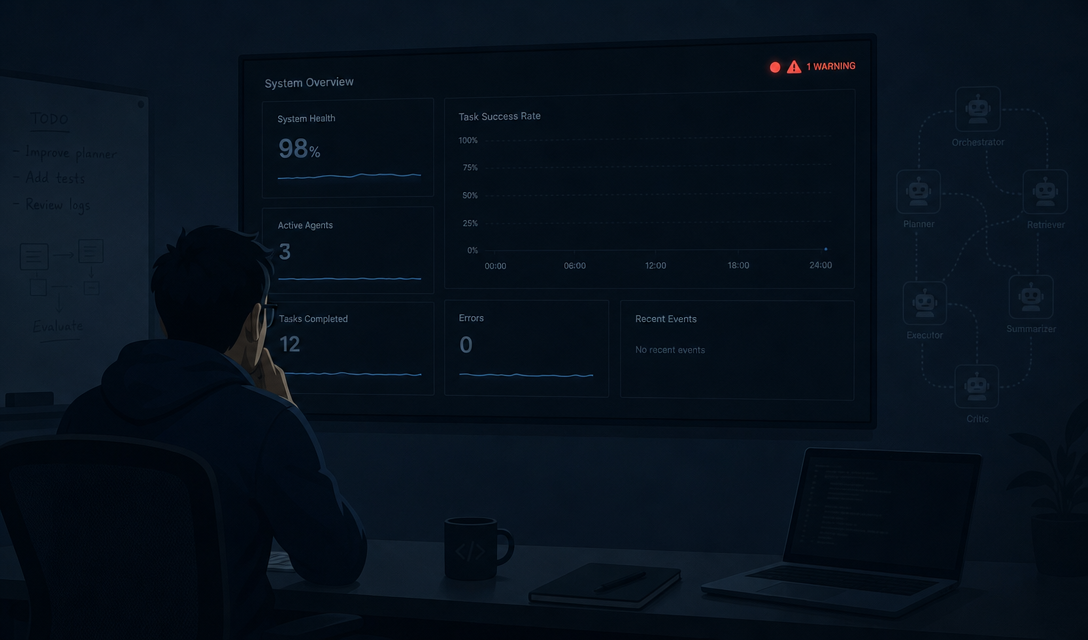
Here's a statistic that stopped me cold: more than 90% of founders running AI agents in production only find out something went wrong when a customer complains.
Not from logs. Not from dashboards. From a support ticket.
This is the AI agent architecture tutorial nobody's writing — not the part about building agents, but the part about knowing what they're actually doing after you ship them.
Why Agent Failures Are Different
Traditional software fails predictably. An API times out. A database query returns an error code. You log it, alert on it, fix it.
AI agents fail in ways that look like success. The agent completes its task, returns output, and moves on. The output is just... subtly wrong. A subtly wrong email drafted. A subtly wrong database entry updated. A subtly wrong customer interaction logged. You won't catch it from a status code because there isn't one.
The hard part isn't building the agent. It's knowing when the agent is doing something wrong that it doesn't know is wrong.
The Manual Log Check Death Spiral
The current state of the art at most AI startups is embarrassing. Engineers build an agent, ship it, then manually spot-check logs every few days. When something looks off, they upload logs to an LLM and ask it to summarize what went wrong. Then they patch the prompt, redeploy, and hope.
This is guess-and-check engineering. And it compounds: the longer your agent runs without proper observability, the harder it is to distinguish systematic failures from one-off noise. By the time a pattern becomes undeniable, you might have weeks of corrupted outputs to untangle.
You can't A/B test your way out of a black box.
What's Actually Missing: Three Primitives
The gap isn't tooling — it's conceptual. Most monitoring tools were built for deterministic software and grafted onto agents as an afterthought. What agent systems actually need are three different observability primitives:
1. Intents — What was the agent actually trying to do? Not what you told it to do, but what it understood the task to be. If there's a systematic gap between the two, that's a brief problem, not a model problem.
2. Corrections — When did a human step in and override the agent? Every correction is a signal. Cluster your corrections and you have a map of where your prompts are failing. Five corrections in the same step of a workflow is a five-alarm fire.
3. Resolutions — How did the task actually end? Completed, abandoned, escalated, retried? An agent that "succeeds" 80% of the time but silently abandons 15% of tasks is lying to your dashboard.
These three dimensions, tracked over time, give you trend lines instead of snapshots. Snapshots show you that something went wrong. Trend lines tell you it was going wrong three weeks ago.
What I've Actually Learned Running Agents in Production
Building on top of Claude and shipping agentic features into production has taught me a few hard things about this gap:
First, the quality of your brief matters more than the quality of your model. I've seen the same underlying LLM produce wildly different output quality on the same task depending on how the agent was prompted. If you're not tracking intents — what the agent understood you to want — you can't diagnose brief quality. You just keep blaming the model.
Second, reactive evals are a trap. If your evaluation suite only tests for problems you've already seen, you're always fighting the last war. Production agents encounter edge cases your test suite never imagined. You need continuous monitoring of live sessions, not just regression tests.
Third, the jump to multi-agent systems makes this dramatically harder. When one agent calls another, the failure surface multiplies. A subtly wrong output from Agent A becomes a confidently wrong input to Agent B. By the time the error surfaces, it's two hops removed from its origin. Without intent tracking at every layer, debugging becomes archaeology.
The Practical Starting Point
If you're running AI agents in production today and don't have structured observability, here's the minimum viable monitoring setup that doesn't require a dedicated observability product:
Log structured intent summaries at the start of every agent session — what the agent parsed as its goal, in one or two sentences. Compare these against your actual task descriptions. Divergence = prompt problem.
Tag every human intervention with a reason code. Even a simple five-option taxonomy (wrong output / missed step / hallucination / format error / other) is enough to start finding patterns.
Track resolution states explicitly. Don't just log success/failure — log how it succeeded or failed. An agent that succeeds by asking three clarifying questions is architecturally different from one that succeeds on the first attempt.
Set trend alerts, not threshold alerts. A 10% increase in corrections over a 48-hour window is more actionable than a single correction crossing a threshold.
None of this requires a new tool. A structured log schema and a weekly 30-minute review of correction clusters will catch more real problems than most agent dashboards.
The Deeper Issue
We're in the middle of a transition from AI as a feature to AI as an operator. When AI is a feature, it fails visibly — a bad recommendation, a misclassified image, something a human immediately notices. When AI is an operator, it runs quietly in the background, making decisions, drafting content, updating records. Its failures are quieter too.
Building good agents is only half the problem. The other half is building the infrastructure to know if they're doing their jobs — before a customer tells you they aren't.
If you're building agentic systems and haven't thought seriously about observability yet, now's the time to start. The tooling is immature, but the primitives are knowable. Don't wait until a customer complaint forces your hand.
I write about building AI agents and shipping profitable SaaS as a solo founder. If this was useful, subscribe for more.
Bagikan ini
Ditulis oleh Feng Liu
shenjian8628@gmail.com